



“What outbound tools should we be using?” is probably the most common question I get asked. The honest answer is that it depends on two things most people don’t think about together: how mature your sales org is, and who you’re actually selling to.
There is no all-in-one platform. Every choice is a trade-off. What follows is a walk through the current state of the sales engagement market, mapped to where you sit – not a ranking, not a definitive recommendation, and not a pitch for any one platform.
The five stages of outbound
Before talking about platforms, it helps to have a mental model for what outbound actually involves. I break it into five stages:
- List building – who are we going after.
- Research – what do we know about them.
- Signal detection – what just changed that makes now the right time.
- Writing and messaging – turning context into relevance.
- Activating prospects in a sequence – the execution layer across email, LinkedIn, phone, SMS, and WhatsApp.
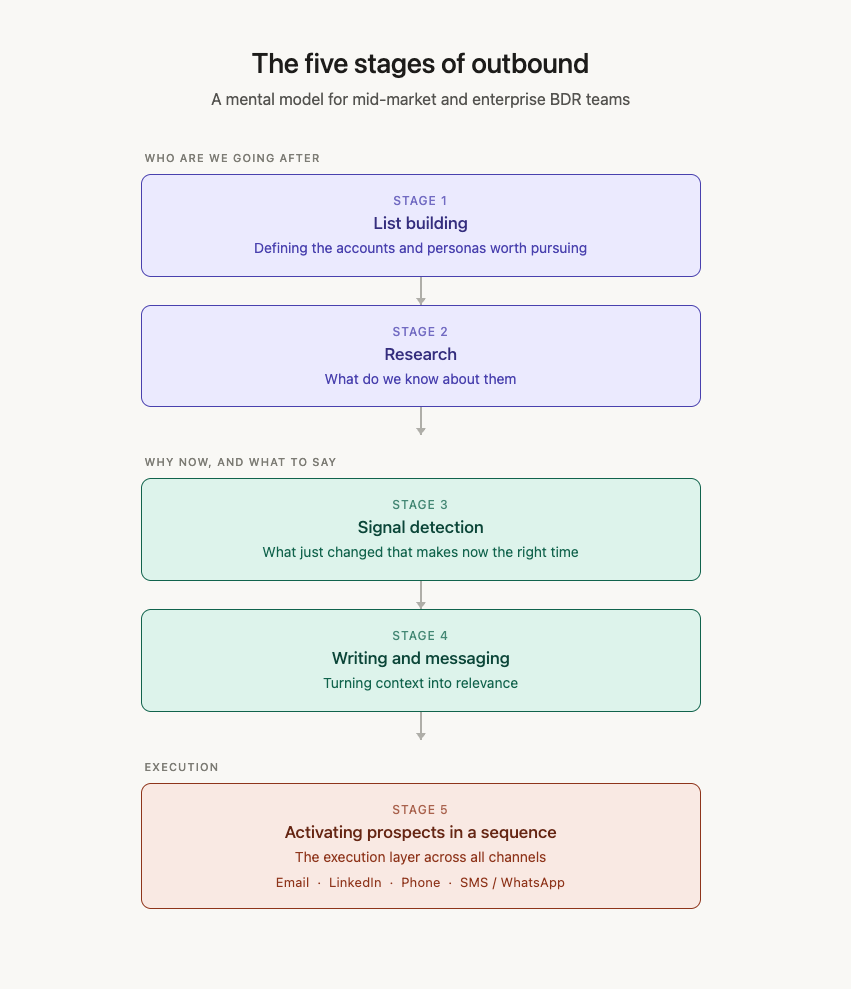
Most platforms are strong in 2–3 of these stages. Almost none are strong across all five. Your stack is a set of decisions about which stages matter most for your motion.
The category landscape
Here’s a quick tour of the main categories so you know what’s what before mapping them to maturity.
Cold email volume tools – Smartlead, Instantly, Lemlist, EmailBison. These are deliverability-focused platforms built for sending at scale. Typically where founders and early teams start. They do one thing well: getting emails into inboxes.
Sequencers – Amplemarket, Apollo, HubSpot, Clay’s sequencer. Lighter, faster to deploy, with modern integrations. The natural next step once the motion becomes more considered and you need more than just email delivery.
Legacy sales engagement platforms – Outreach, SalesLoft, Gong Engage. Deep account insights, stakeholder mapping, account history, rep management. AI has been bolted on. Worth calling out the seat minimums – roughly 8–10 seats – which means they’re not built for small teams. If you’ve got three reps, you’re not buying Outreach.
AI-native platforms – Unify, Nooks. AI as architecture rather than an add-on. Signal-driven, enrichment inline, messaging generated with real context. These are the platforms that were built from scratch around AI rather than retrofitting it.
Dialers – Orum, SalesFinity, Aircall, Trellus, Nooks. The split here is between power dialers and parallel dialers. Power dialers tend to fit mid-market and enterprise books of business better, where you’re calling fewer accounts but spending more time per conversation. Nooks is the closest thing to all-in-one for dialing-heavy teams.
AI SDRs – Alta, Artisan, 11x. The honest take: these are not a full replacement yet. They only work on top of a sequence that’s already been proven manually. Where AI genuinely helps today is with signals, enrichment, routing, and first drafts – with a human in the loop.
The framework: maturity × target market
The rest of this piece maps those categories to a two-axis framework. On one axis is the maturity of your sales org. On the other is who you’re selling to.
Why both matter: a founder selling six-figure enterprise deals needs a completely different stack to a founder selling £99/month SMB. Same stage, totally different tools.
Founder-led
1–2 sellers, still finding ICP and message. The priority at this stage is to learn fast and keep it lightweight.
SMB / startup motion: Smartlead, Instantly, Lemlist. Volume-led cold email with a focus on deliverability. You’re testing messaging, iterating fast, and trying to find what resonates. You don’t need orchestration or account intelligence yet – you need to get emails into inboxes and learn from the responses.
Mid-market motion: Amplemarket. Signal-aware sequencing with richer research baked in. At mid-market, you can’t just blast volume – the accounts are bigger, the deals are more considered, and you need more context per outreach.
Enterprise motion: Amplemarket. A lean AI-native foundation to run account-led outreach from day one. Even as a solo founder selling enterprise, you need signal detection and research capabilities. You just don’t need the governance and rep management layer yet.
Warning signs at this stage: buying Outreach before you have a team to manage, or hiring an AI SDR before the motion works manually.
First sales hires
2–5 reps, playbook forming. The priority is to codify what works and make it repeatable.
SMB / startup motion: Apollo, Amplemarket, HubSpot. Sequencing with built-in data and basic reporting. You need to see what’s working across multiple reps and start building a repeatable process.
Mid-market motion: Nooks, Amplemarket. Signal-led sequencing with dialing built in. For multi-threaded mid-market accounts, you need phone alongside email and LinkedIn. Nooks combines dialing with sequencing in a way that makes sense at this stage.
Enterprise motion: Nooks, Amplemarket, Unify. The seat minimums on legacy platforms like Outreach and SalesLoft often rule them out with 2–5 reps. AI-native tools carry you until the team is big enough to justify those platforms.
Warning signs at this stage: over-automating before the message is proven. If your reps can’t book meetings with a manual process, no amount of sequencing is going to fix that.
Scaling the engine
First SDR pod, RevOps emerging. The priority is to scale without losing quality.
SMB / startup motion: Amplemarket for tier 1 and tier 2 accounts, Smartlead, Instantly, or EmailBison for higher-volume plays. This is where a tiered approach starts making sense – your best accounts get the signal-driven, researched outreach, while the longer tail gets volume treatment.
Mid-market motion: Amplemarket, Unify, Nooks, Outreach. The AI-native layer feeds signals and messaging, dialing runs alongside, and you might be hitting the point where Outreach’s orchestration starts to earn its weight.
Enterprise motion: Outreach, SalesLoft, Gong Engage, Nooks, Unify. Orchestration runs the rep’s day. Dialing is handled by Nooks. AI and signals feed in via Unify. This is where the stack gets more layered because the complexity of enterprise selling demands it.
Warning signs at this stage: buying three overlapping tools because each one promised “all-in-one.” You end up with a Frankenstein stack where nothing integrates properly and RevOps is spending half their time duct-taping workflows together.
Mature sales org
Multi-team, territories, RevOps and enablement in place. The priority is orchestration, governance, and account intelligence.
SMB / startup motion: At this scale, SMB motions tend to run on the same stack as the rest of the organisation. The platforms are the same as mid-market and enterprise.
Mid-market motion: Outreach, SalesLoft, Gong Engage, Nooks, Unify. Orchestration plus dialing, with AI and signals layered in. The account intelligence these platforms provide – history, stakeholder mapping, activity logging – becomes essential when you’ve got territories, handoffs, and multiple reps touching the same accounts.
Enterprise motion: Outreach, SalesLoft, Gong Engage, Nooks, Unify. Account intelligence becomes the backbone. At this point, the SEP isn’t just a sequencing tool – it’s the system of record for how your team engages with accounts.
Warning signs at this stage: ripping out the legacy SEP because it “feels old” without replacing its account intelligence. The new AI-native platforms are exciting, but they don’t yet have the depth of account history, rep management, and governance that platforms like Outreach have built over a decade.
The grid
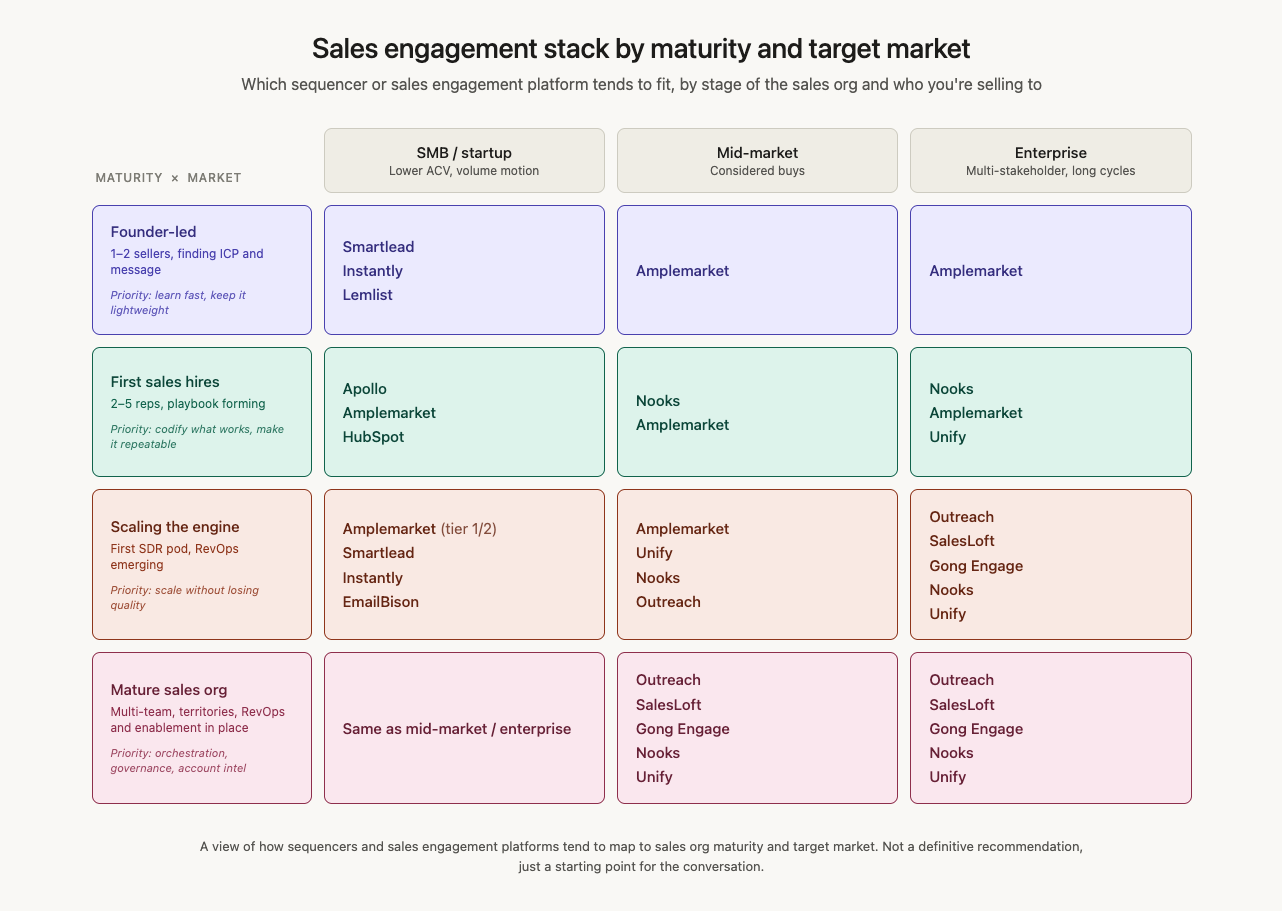
I put together a maturity × market grid that maps all of this into a single visual. It’s a starting point for your research, not a buying list.
There’s enormous nuance that a 4×3 grid can’t capture: your CRM, your data sources, your dialer, your AI SDR strategy, your team structure, your reporting needs, your budget. Think of it as the first filter – the shortlist to start looking at, not the shortlist to purchase.
Check out the video below, which walks through each of these sales engagement platforms: