



Outbound really is that simple.
Most outbound teams start with the message.
They spend hours writing the perfect email, A/B testing subject lines, arguing over whether to use the prospect’s first name or their company name in the opener. Then they blast it out to a list they pulled three weeks ago.
And they wonder why nobody replies.
The problem isn’t the message. The problem is the order.
Outbound prospecting starts with the right person
Before you write a single word, you need to know exactly who you’re talking to. And “who” isn’t one question. It’s two.
Step one: define the companies
Most teams describe their ICP in broad strokes. “B2B SaaS, 50 to 500 employees, UK or US.” That’s a category, not a segment.
A funded 80-person startup that’s never had a dedicated onboarding tool has completely different needs, buying speed, and budget to a 400-person company with a mature CS function where onboarding has gone stale.
Let me use a fictional company called Clarion to make this concrete.
Clarion sells B2B customer onboarding software. I built them as a demo company because I can’t share client data, but the setup is typical of the conversations I have every week.
Clarion has two ICPs:
ICP 1: The Scaling SaaS Company. 50 to 200 employees. Recently funded (Series A or B within the last 12-18 months). Growing their customer base fast.
Customer success function exists but is still being built out. They’ve never had a dedicated onboarding tool and they’re starting to feel the pain of doing it manually or bodging it together in a project management tool.
Decision speed is quick because the founder or a senior leader controls budget and the pain is fresh.
ICP 2: The Established Mid-Market. 200 to 500 employees. Series B or C. They have a mature CS function, but onboarding is inconsistent across the team.
They might be using Gainsight or ChurnZero for the broader CS workflow, but onboarding itself runs on spreadsheets, Notion pages, or whatever each CSM has put together on their own.
The trigger here is usually a new CS leader arriving with a mandate to professionalise, or churn numbers that have started creeping in the wrong direction.
Decision cycles are longer because there’s more internal alignment needed.
Those two ICPs look similar on paper if you squint, but they buy for different reasons, at different speeds, with different internal dynamics. If you treat them the same, your messaging will be too generic for either.
You might even create subsegments within these ICPs. For example, fintech companies onboard customers differently to HR tech companies. Whenever there is a difference in the way that somebody describes the challenges or needs, my advice is to always segment.
Step two: map the personas within each ICP
Inside each ICP, different people care about different things and describe their problems in different language. This is where most teams stop too early.
They pick “Head of Customer Success” and write one message for that title across every company.
What I build with clients is an ICP buyer persona matrix.
Your ICPs across one axis. Your personas across the other. And in each cell: the specific challenges that persona faces, the desired outcomes they care about, and how your solution maps to each one.
For Clarion, the matrix might look like this:
The VP of Customer Success (relevant across both ICPs, but the pain is different). In ICP 1, they’re building the function from scratch and trying to prove that CS drives revenue, not just support tickets. They care about time-to-value and retention metrics they can take to the board.
In ICP 2, they’ve inherited a team where every CSM runs onboarding differently and nobody follows the templates. They care about consistency and being able to show their new leadership that the function is under control.
The CS Operations Manager (mostly ICP 2). They don’t care about board-level metrics.
They care about the fact that onboarding is a mess operationally. Different CSMs using different processes, no visibility into where customers are getting stuck, no way to report on what’s working. They want a system, not a strategy deck.
The Head of Product (mostly ICP 1). They care about how onboarding connects to activation and adoption.
If customers aren’t getting to the “aha moment” quickly enough, that’s a product problem as much as a CS problem. They’re thinking about onboarding as a product experience, not a people process.
Each of those people uses different language to describe their problems and needs a different messaging angle.
The VP of CS doesn’t care about workflow automation. They care about reducing churn and proving impact.
The CS Ops Manager doesn’t care about board presentations. They care about the fact that last quarter’s new hire onboarded customers completely differently to the CSM who’s been there two years.
It takes work up front. But once it’s built, every piece of outbound you do becomes sharper because you know exactly who you’re speaking to and why they should care.
A practical test: ask three reps to describe the top three problems their primary persona faces.
If the answers are vague or inconsistent, the persona work hasn’t landed. The documentation might exist, but it hasn’t translated into what reps actually say when they pick up the phone.
Top-performing outbound teams treat their ICP as a working hypothesis that gets refined every quarter, not a fixed segment frozen in a sales playbook.
They run cohort analysis on which closed-won customers actually became reference accounts, which became cost-to-serve problems, and which produced expansion revenue. That analysis feeds back into the matrix so the targeting gets sharper over time.
Then find the right time to prospect
You’ve identified who to talk to. Now the question is: when?
Step one: score and tier your accounts from closed-won data
Before you layer on any signals, you need to know what a good account actually looks like for your business. And the only reliable source for that is your own closed-won data.
This is the step most teams skip or get wrong. Before you build anything, before you try to build a prioritisation system, you need to define what you’re actually scoring for.
What makes an account high priority for your specific business?
For Clarion, I defined five must-have criteria based on what their best customers have in common: B2B SaaS company, 50 to 500 employees, UK or US headquarters, existing customer success function, and using Salesforce or HubSpot (because that’s what the tool integrates with).
They also needed at least 30 active customers, because below that threshold onboarding isn’t painful enough to buy software for it.
If an account doesn’t pass those gates, the rep doesn’t work it. Full stop. I see time and again reps spending hours researching and reaching out to accounts that aren’t even a fit in the first place.
Step two: layer signals on top to prioritise
Once your accounts are qualified, signals tell you which ones to work now.
The data on this is clear. Signal-based outbound achieves 15-25% win rates compared to 8-15% for cold outbound with no signal or intent data supporting the timing.
Stacked signals (multiple converging signals on one account) convert at 5-10x the rate of cold outreach. The timing isn’t a nice-to-have. It’s where a significant chunk of the performance difference lives.
Some signals are common across almost every B2B company. A company just raised funding. They’re hiring in the department your solution serves. A new leader just joined in a relevant role. They’re expanding into a new market.
But the signals that really matter are the ones specific to your business. I call these custom signals.
For Clarion, a company hiring multiple CS roles is a strong signal because it means their customer base is growing and onboarding is about to get stretched. A company using Notion, Asana, or Trello for CS workflows is another: they don’t have a purpose-built tool, which means they’re bodging it.
A company currently on Gainsight but with no dedicated onboarding tool has a specific gap that Clarion fills.
When you score accounts against both the must-have criteria and the live signals, they naturally fall into tiers:
Priority accounts pass all the gates and are showing multiple active signals right now. A new VP of CS just joined, they’ve posted four CS hiring signals in the last month, and they were funded in the last 12 months. These get worked first, with the most effort per account.
Active accounts pass the gates and have one or two signals but nothing urgent. They’re worth working, but with less intensity than Priority.
Watch accounts fit the ICP but aren’t showing any activity. They stay on the radar but don’t get rep time until something changes.
Not Now accounts don’t fit or have actively disqualified themselves. They come off the list entirely.
The tiers aren’t permanent (and you can name them however you like).
An account sitting in Watch for three months can jump to Priority overnight when a leadership change hits. That’s the whole point of tracking signals in real time rather than working from a static list.
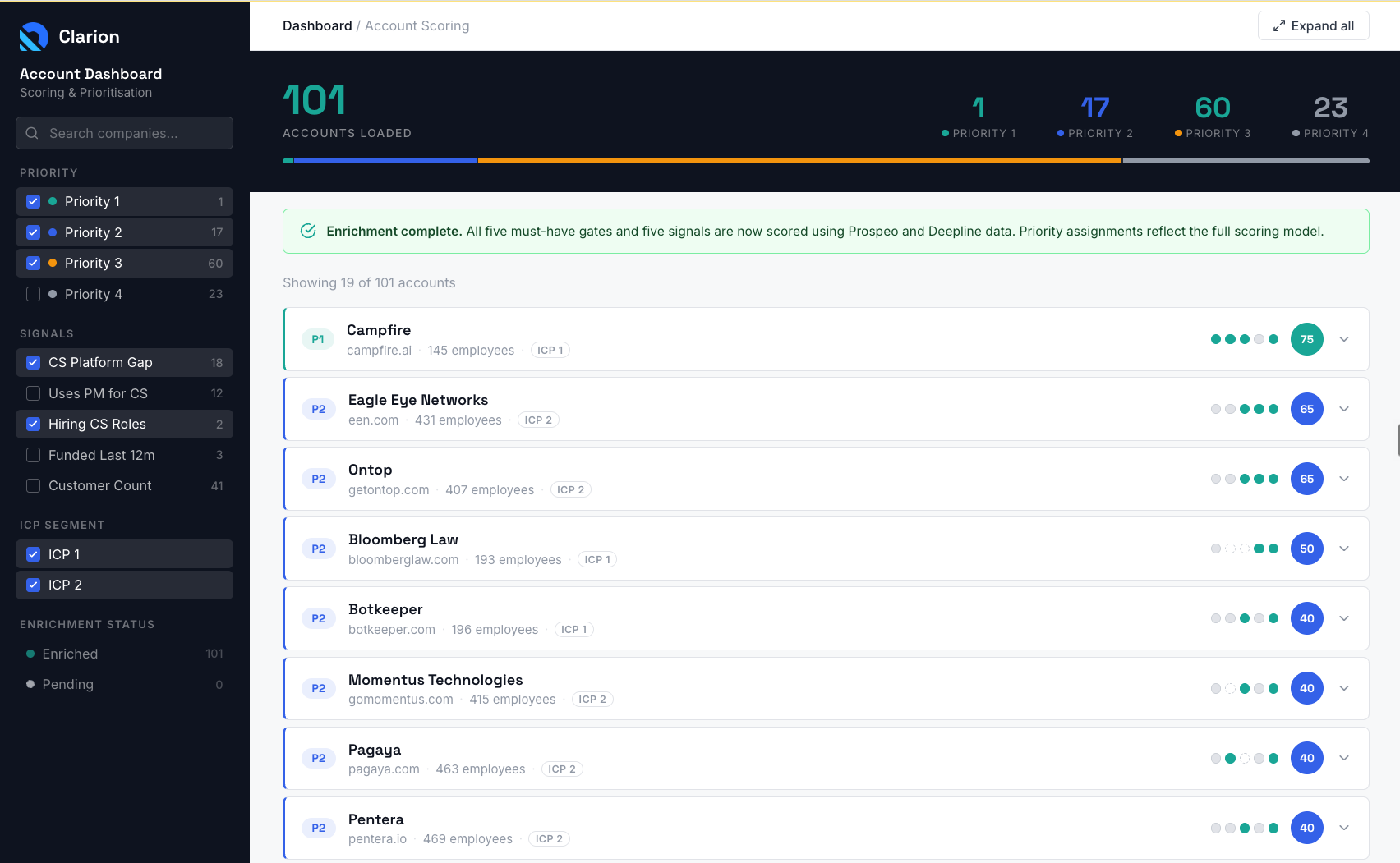
I built an account dashboard for a client recently where they had 101 accounts loaded. Of those, one was Priority, 17 were Active, 60 were Watch, and 23 were Not Now.
When a rep logs in on a Monday morning, they know exactly where to start. No tabs. No guessing. No spreadsheet sorted alphabetically.
You can see a demo account dashboard with account scores and signals here: Account Prioritisation Dashboard
Without a system like this, here’s what actually happens.
I’ve sat with reps who have 15 tabs open, manually checking LinkedIn, job boards, news sites, CRM, and funding databases.
One team had reps spending five to six hours a week each on this research before they even picked up the phone. Do the maths: 5 hours a week per rep, 10 reps, that’s 50 hours a week.
Over a year, that’s 2,500 hours spent on something a system can do in minutes.
And it’s not just the time. While a rep is manually researching account 12, account 76 just posted three hiring signals and they’ll never see it.
The opportunity passes. A competitor reaches out at the right time instead.
Step three: find the contacts and verify the data
Once you know which accounts to work and which personas to target, the next step is finding the actual people. This is where you identify specific contacts at each account and run waterfall enrichment to verify their email addresses.
You don’t enrich every contact in your TAM. You enrich the ones at Priority and Active accounts, for the personas you’ve already mapped. That keeps your enrichment spend focused on people who are actually worth reaching.
There’s no point paying to verify 10,000 emails when only 200 of those contacts sit at accounts that are showing buying signals right now.
Also, you always want to find the contact and verified data as close to the date that you’ll be enrolling the prospect in a sequence (because people move, companies move, and the majority of databases are slightly behind these movements)
The outbound message comes last
Most people start here. But if you’ve done the first two steps properly, the message is the part that takes the least effort.
When you know exactly who you’re talking to (the persona, their challenges, their desired state) and why now is the right time (the signal that triggered this outreach), you’re not starting from a blank page. You’re starting from context.
But the message isn’t just for email. It’s the talk track your reps use on cold calls. It’s the hypothesis they carry into every conversation: why this company, why now, and why us.
Describe the consequence of the signal, not the signal itself
The signal is the starting point, but the signal itself isn’t the message. The real work is thinking through the consequences of that signal for this specific person.
Take Clarion’s example. The signal is: this company has hired four CS roles in the last two months. The consequence for the VP of CS is: when CS teams scale that quickly, the biggest risk is inconsistent onboarding across the new hires, each one building their own version of the process.
New CSMs default to whatever worked at their previous company, and within a quarter you’ve got five different onboarding approaches running in parallel.
That consequence is the message.
Not “I noticed you’re hiring” (which every vendor in their inbox is saying) but a specific description of the operational problem that hiring creates.
A company just opened three new offices in Europe. So what? They’re probably onboarding dozens of new employees across different countries, dealing with local compliance requirements they haven’t handled before, and their existing HR system might not support multi-country payroll.
Signal without a play is trivia. Signal with a play is pipeline.
Allude to how other companies have solved the problem
Once you’ve described the consequence, the prospect needs to know this is solvable and that companies like theirs have already solved it. You’re not pitching your product at this point. You’re referencing a pattern.
“When CS teams scale that quickly, the biggest risk is inconsistent onboarding. That’s the problem we’ve helped [type of company] solve, and the teams that fix it early typically see measurable improvement in time-to-value within the first quarter.”
The prospect should feel like they’re hearing from someone who understands their situation and has seen it play out before, not someone reading features off a website.
Structure and the pub test
I like to structure the message in four parts:
- The observation or signal. Something you’ve noticed about their situation. This is what earns you the right to the rest of the email or call.
- The problem statement. The challenge that observation creates for them specifically.
- The impact or consequence. What happens if they don’t address it, or what it’s costing them right now.
- The solution. A hint that there’s a way to address it, ideally referencing how similar companies have handled the same situation.
And everything runs through the pub test. Would you say this to someone in a pub?
Not a pitch. Not a brochure. A conversation between two people who respect each other’s time. If it sounds like marketing copy, it fails.
If it sounds like something a prospect would say to a friend or colleague at the pub, it’s right.
Why the order matters more than any individual prospecting step
If you start with the message (like most teams do), you end up with great-sounding copy sent to the wrong people at the wrong time. Open rates might look reasonable. Reply rates will be dismal. And you’ll conclude that “outbound doesn’t work” when the real problem is that you skipped the first two steps.
And this isn’t just about the email. It’s about the hypothesis behind every touchpoint. When a rep picks up the phone, they need to know why this company, why now, and why us.
That hypothesis comes from the persona work and the signal work. Without it, the rep is winging it. With it, they sound like an expert who’s done their homework, because they have.
The average B2B buyer now receives 80-150 cold emails per week. In that environment, a well-written email to a poorly targeted list is invisible. But a message that arrives at the exact moment someone is dealing with the problem you solve, written in the language of their specific role, referencing a change that just happened in their business? That stands out. Not because of clever copywriting. Because of relevance.
The data backs this up across the funnel. Deals with three or more engaged contacts (multi-threaded) close at 2.4x the rate of single-threaded deals.
That means getting the right person isn’t just about finding one contact. It’s about understanding the full buying committee and engaging the right stakeholders. The persona matrix gives you that map.
And the performance gap between teams that do this well and teams that don’t is widening. The gap between top performers and the rest has gone from 7x to 11x in just two years.
AI amplifies existing quality. Strong fundamentals plus AI equals dramatically better results.
Weak fundamentals plus AI equals faster failure at greater scale.
Where AI fits in outbound prospecting
I use a framework called the Effective Seller to help teams figure out where AI and automation should sit in their process.
Automate the tasks that don’t need a human. Signal tracking, account scoring, data enrichment, list building. These are the tasks that eat up a rep’s week in manual research. AI can do all of this faster and more consistently than a person.
Account research that previously took 15-20 minutes per prospect can be compressed to 2-3 minutes with well-prompted AI assistance.
Augment the tasks where AI makes a human better. Message drafting, account research summaries, call preparation, stakeholder mapping.
The rep still makes the decision, but AI gives them a head start. Instead of spending 20 minutes researching an account, the rep gets a brief that tells them the key signals, the recommended messaging angle, and the persona to target.
Tools like Nooks have built this into their sequencer. You build one sequence for multiple signals, and AI agents within the sequence ingest the context to write messages that are situationally relevant.
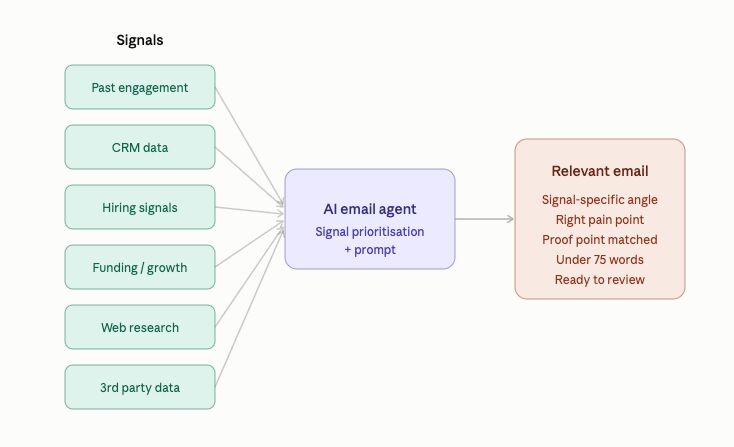
You go from needing multiple sequences on a per-signal basis to having one core signal-based sequence where the AI adapts the email based on whichever signal is most relevant.
The heavy lifting isn’t in the writing. It’s in the thinking that happens before the writing.
But all of this only works if the thinking is captured somewhere your reps and your AI tools can actually access it. The persona matrix, the account scoring criteria, the signal-to-consequence mappings, the messaging structure.
It all needs to live in a single sales playbook that reps can query at any time. Not a PDF buried in a shared drive. A working document that connects ICP definitions to messaging angles to the signals that trigger outreach.
Think of this sales playbook as your context layer for AI.
When that playbook exists, it becomes the input for AI-generated messaging. The AI doesn’t need to start from scratch because the playbook already contains the persona challenges, the consequences of each signal, and the structure every message should follow.
The quality of your AI output is directly proportional to the quality of the playbook feeding it.

Keep human the moments that actually matter. The phone call. The discovery conversation. The negotiation. The relationship. These are the parts where empathy, judgement, and trust make the difference.
The mistake I see most often is premature automation. A team has messaging that converts at a 0% reply rate on 50 emails.
So they 10x the volume to 5,000, thinking scale will fix the problem. It won’t. You’ve just scaled a broken process.
Volume without relevance is actively counterproductive. It burns your domain, damages your brand, and exhausts your TAM.
Fix the targeting. Fix the timing. Fix the message. Then scale.
What to do with your outbound prospecting
Look at your outbound right now and ask yourself three questions:
Do your reps know exactly which persona they’re targeting at each account, and how your solution maps to that persona’s specific challenges? If not, build the matrix. It takes work, but everything downstream depends on it.
Are your accounts scored from closed-won data and prioritised based on live signals, or are reps working from a static list that was pulled weeks ago? If it’s static, start with the scoring criteria. Even before you track signals, knowing what a good account looks like for your business changes how reps allocate their time.
Is your messaging built from the consequence of a signal or situation, or are you leading with product features? If it’s features, flip it. Start with what’s happening in the prospect’s world, describe the problem that creates, and then reference how similar companies have addressed it.
The order matters. Right person. Right time. Right message. Get them in sequence and outbound stops being a volume game and starts being a relevance game.
And relevance is the one thing your competitors can’t automate their way into.
I help B2B SaaS teams fix, build, and scale their outbound. Whether it’s an audit, a playbook, or a full AI-enabled system, get in touch.